Overview
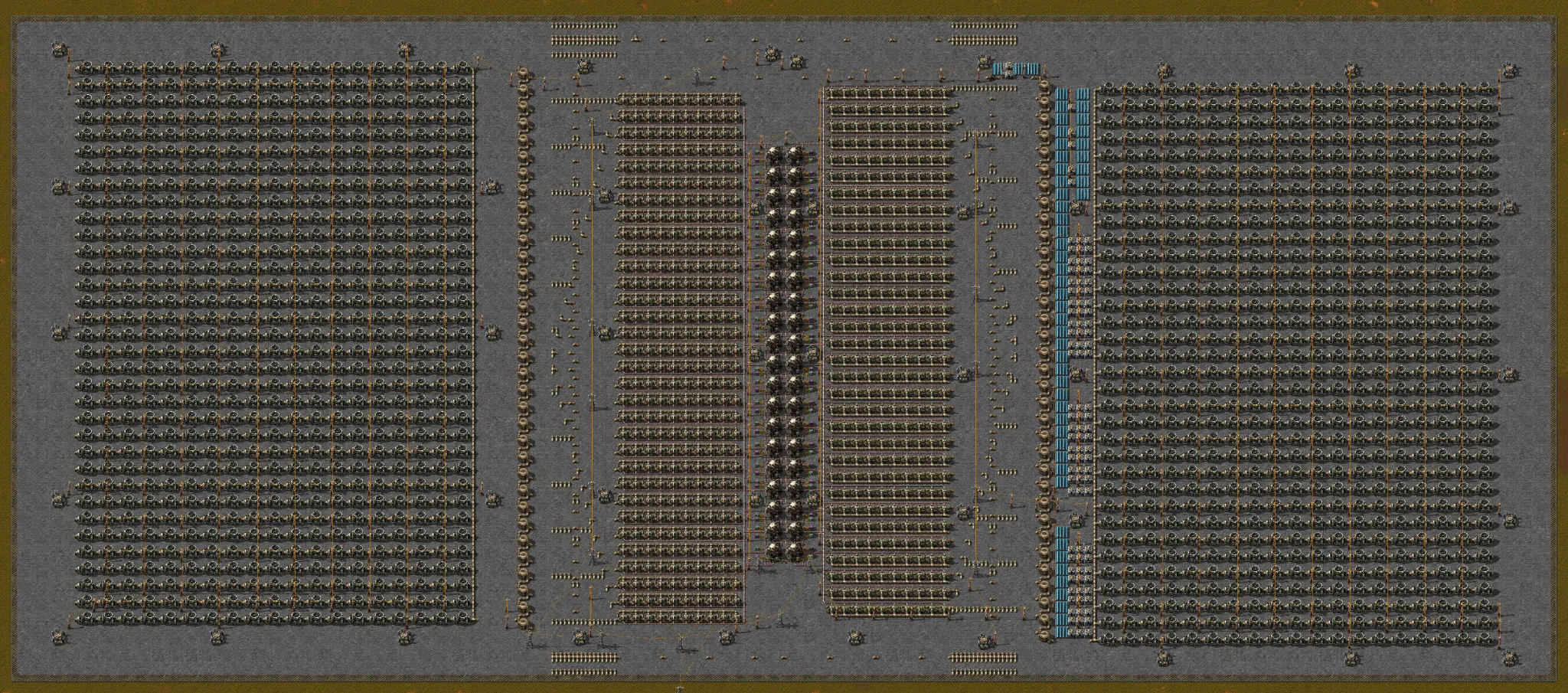
Nuclear power plant with 40 reactors in two columns of 20, 640 heat exchangers and 1,292 steam turbines, which delivered up to 6,136 MW in the measurement. It is version 2 of the 40-reactor plant: it does not have version 1's protection circuit, and its fuel inserters and pump have their own network of solar panels and accumulators, separate from the turbines' network, so they keep running even when the base asks for more than the plant produces; the repository owner recommends it over version 1.
- File:
nuclear-power-plant-40-reactors-v2.txt — blueprint string; in-game, its name is Nuclear power plant - 40 reactors v2.
- Origin: the repository owner's design, adapted from a ready-made design by an unknown author; no license is known.
- This is always the current version of v2; earlier versions of it live in the git history.
nuclear-power-plant-40-reactors-v1, with a protection circuit, is a different design and stays in the catalog.
What's inside
| Item |
Value |
| Entities |
8,809 |
| Area |
370 × 159 tiles |
| Heat pipe |
2,294 |
| Pipe |
2,403 |
| Pipe to ground |
1,205 |
| Steam turbine |
1,292 |
| Heat exchanger |
640 |
Bill of materials
Everything the blueprint uses, counted by the catalog validator from the string:
| Item |
Quantity |
| Concrete |
57,776 |
| Pipe |
2,403 |
| Heat pipe |
2,294 |
| Steam turbine |
1,292 |
| Pipe to ground |
1,205 |
| Hazard concrete |
1,054 |
| Heat exchanger |
640 |
| Medium electric pole |
493 |
| Accumulator |
97 |
| Inserter |
80 |
| Storage tank |
68 |
| Solar panel |
53 |
| Roboport |
44 |
| Requester chest |
40 |
| Active provider chest |
40 |
| Nuclear reactor |
40 |
| Big electric pole |
19 |
| Pump |
1 |
All four edges end in a one-tile strip of hazard concrete; right inside it, and across the rest of the floor, the ground is concrete.
Differences from v1
Comparison with nuclear-power-plant-40-reactors-v1, generated by a script from the two strings:
| Item |
v1 |
v2 |
| Pump |
66 |
1 |
| Decider combinator |
1 |
0 |
| Power switch |
1 |
0 |
| Solar panel |
1 |
53 |
| Accumulator |
2 |
97 |
| Pipe |
2,137 |
2,403 |
| Pipe to ground |
1,321 |
1,205 |
| Medium electric pole |
488 |
493 |
- No protection circuit: version 2 has neither the decider combinator nor the power switch of version 1, so the base connects directly to a big electric pole of the turbines' network.
- Only one pump: version 1 had 66 pumps between the tanks and the turbines, and version 2 has one. The steam runs in two independent halves, west and east, and the single pump links one to the other (see "How the steam is distributed").
- A network of its own for the inserters and the pump: the 80 fuel inserters and the pump sit in a group of poles apart from the turbines' group, with 53 solar panels and 97 accumulators (485 MJ); version 1 had only 1 solar panel and 2 accumulators, for its combinator.
- Same as version 1: the 40 reactors, the 640 heat exchangers, the 1,292 turbines, the 68 tanks, the 80 inserters, the 44 roboports, the 80 chests, the 64 water inputs and the fuel-saving logic (the inserters' conditions are the same).
- Water: 64 pipes to ground, 32 on the north edge and 32 on the south edge. Connect each one to a water source; at full power the plant used about 6,300 units of water per second (measured: 6,326 per second at a 7,000 MW demand; calculated: 10.3 per second for each of the 624 heat exchangers needed for 6,240 MW, for a total of 6,430).
- Fuel: 40 requester chests ask for 10 uranium fuel cells each; the logistic robots of the 44 roboports bring the cells, and the depleted uranium fuel cells leave through the 40 active provider chests. The blueprint does not include any robots: the logistic network needs logistic robots, a chest with uranium fuel cells and a chest that takes the depleted cells.
- Base: connect the base to one of the 19 big electric poles, which belong to the turbines' group, for example the one at the center, 12 tiles north of the south edge. Do not connect the base to the poles of the fuel inserters or the solar panels: that would put the base's demand on them and undo the separation.
- Startup: as in version 1, a reactor gets fuel from its chest only after a depleted cell leaves it, so put one uranium fuel cell into each of the 40 reactors manually. Measured: in daylight and with no external power source, the plant started this way and refueled itself, and the accumulators filled within the first 10 minutes.
Consumption and production
| Item |
Per second |
| Electric power delivered (measured maximum) |
6,136 MW |
| Uranium fuel cell consumed |
0.2 (12 per minute) |
| Depleted uranium fuel cell produced |
0.2 (12 per minute) |
| Water consumed |
about 6,300 |
Values measured at full power, with 39.9 of the 40 reactors burning (one cell per reactor every 200 s); the power delivered is that of the measurement with a 7,000 MW demand. The calculated values are 6,240 MW (40 reactors of 40 MW with 116 neighbor bonuses of 100%) and 6,430 units of water per second.
How the steam is distributed
In version 1 the steam formed a single network. In version 2 there are two independent halves, west and east, each with 320 heat exchangers, 646 turbines and 34 tanks, all fed by the same water network. The single pump, near the north edge and powered by the solar network, moves steam from the west half to the east half. The 40 fuel-saving thresholds read a tank of the east half; the steam level of the west half is not monitored. In the measurements, the two halves worked equally (with 646 turbines in each, outside startup and the total blackout), and the pump worked 100% of the time under load.
How the plant saves fuel
In the base game, a reactor with fuel burns nonstop, even when nobody uses the heat. Here each reactor gets a new cell only after its depleted cell is taken out, and the 40 inserters that take out the depleted cells are wired with a green wire to a storage tank in the east column, near the south edge. Each pair of reactors has a threshold: the first is refueled only while that tank holds less than 24,000 units of steam, the next less than 23,000, and so on in steps of 1,000, down to 5,000 for the last pair. That tank must stay in the steam network.
How the separate network keeps the inserters running
In version 1, the pumps and the fuel inserters ran on the plant's own power, so a switch cut off the base when it demanded more than the plant produced. Version 2 has no such switch: the solar network's poles have no copper wire to the turbines' group, where the base connects. The solar network holds the 80 inserters, 53 solar panels, 97 accumulators, the single pump and 7 of the 44 roboports; the other 37 roboports stay in the turbines' group (counted by a script on the string and confirmed in the game).
The idea of the design, according to the repository owner, is to keep the whole plant running at maximum output all the time, even if the base starts demanding more than the plant produces. The 32 solar panels and 90 accumulators that were added extend along the tanks to the end of the column, and they exist only where no pole or roboport of the turbines' group reaches, so as not to join the two networks. With the base idle, the 53 panels give up to 3,180 kW by day against about 400 kW consumed by the group (measured), and the surplus recharges the accumulators.
Results measured in-game
Measured in Factorio 2.0.77 with this entry's blueprint (same entities and wires; only the description text was changed afterwards). Each row is the average of 18,000 ticks (5 min), after 18,000 ticks (5 min) at the same load; power comes from the game's electric statistics; water, from its fluid statistics; and cells burned, from the average number of reactors burning, divided by 200 s (the life of one cell). The calculated maximum is 6,240 MW.
| Load requested by the base (MW) |
Delivered to the base (MW) |
Cells burned |
Water |
| 3,000 |
3,000 |
0.10/s |
2,952/s |
| 5,000 |
5,000 |
0.17/s |
5,129/s |
| 6,000 |
5,940 |
0.20/s |
6,124/s |
| 6,240 |
6,080 |
0.20/s |
6,268/s |
| 7,000 |
6,136 |
0.20/s |
6,326/s |
| 5,000, after the overload |
5,000 |
0.18/s |
5,291/s |
Solar network, measured at the same time. In the night rows, the game was held at midnight and the base asked for 5,000 MW. The measured windows of the night and recharge rows last 9,000 ticks (150 s) and start 3,000 ticks (50 s) into the phase, except the one with 3 MW of extra load, which is the last 6,000 of the phase's 18,000 ticks; the daytime 7,000 MW row uses the 18,000-tick window of the previous table.
| Situation |
Solar network load (kW) |
Accumulators (MJ) |
Inserters without power |
Pump working |
| Base asking for 7,000 MW, by day |
387 |
485, full |
0 of 80 |
100% |
| Night, no extra load |
397 |
464 → 405 |
0 of 80 |
100% |
| Night, with 1 MW extra |
1,406 |
336 → 125 |
0 of 80 |
100% |
| Night, with 3 MW extra |
no power |
0 |
40 of 80, on average |
0% |
| Day again, no extra load |
391, and 2,789 go to the accumulators |
46 → 465 |
0 of 80 |
100% |
- Base overload: with a 7,000 MW demand, the plant delivered 6,136 MW, with 39.9 of the 40 reactors burning and all 1,292 turbines working. The 80 inserters and the pump had power the whole time, the fuel kept flowing (0.20 cells per second) and the accumulators stayed full. In version 1, without the circuit, the same load collapsed the plant (221 MW).
- With 6,000 to 7,000 MW requested, the delivery stayed below the demand (5,940, 6,080 and 6,136 MW) with the reactors' temperature still rising (707 → 735, 753 → 767 and 775 → 783 °C): the sustained maximum was not measured at thermal equilibrium, and it is around 6,100 MW or more.
- Startup: with no external power source, by day, with one cell in each reactor, the plant started by itself and refueled itself (40 cells swapped in 10 minutes, with 26.6 of the 40 reactors burning on average), and the accumulators went from 0 to 485 MJ in that time.
- Night: the 485 MJ covers the solar network's 397 kW load for about 20 minutes (calculated from the measured drop) and, with 1 MW extra, for about 6 minutes. With 3 MW extra, the roughly 125 MJ left from the previous phase ran out in about 40 s (calculated; starting from full accumulators it would be about 2.4 minutes), the inserters stopped, the reactors ran out of cells and the plant went dark (0 MW). In that phase the game counted 40 of the 80 inserters as unpowered, on average, and did not count the other 40 that way; what was measured is the outcome: no cell delivered, no reactor burning and 0 MW.
- After the total shortage, when daylight returned the plant restarted by itself: between 50 s and 200 s later, the 40 reactors were burning again and it delivered 4,957 MW against the 5,000 MW requested.
- Roboports: with 6,000 MW or more requested, the 37 roboports of the turbines' group were all at low power; the 7 of the solar network never were, except at startup, while they filled their internal batteries, and in the total blackout (5.7 of the 7 at low power, on average).
- Steam: in every phase except startup and the total blackout, 646 turbines worked in each half, and no turbine was idle at tick 40,000.
How it was tested
Two runs in the game. In the first, the catalog's photo runner imported and built the 8,809 entities of the blueprint and connected it to a power source; 1 of the 2 pole groups was out of the source's reach, and the test joined it with an added wire, which links the two networks only in the test. The image comes from that run and shows the blueprint built, not running.
In the second, a test scenario made for this entry (not included in the repository) built the blueprint on a lab surface, by day, put infinite water on the 64 inputs and stood in for the logistic robots: every second it topped each requester chest up to 10 uranium fuel cells and emptied the active provider chests. The scenario put one cell into each reactor, with no external power source at all. The base was an adjustable electric load connected to a big electric pole of the turbines' network; a second load, connected to a pole of the solar network, simulated the extra consumption of robots; and the night was held by fixing the surface's time at midnight. The game confirmed that the two networks are separate and that the solar network holds the 80 inserters, the 53 panels, the 97 accumulators, the pump, 7 roboports and no turbine. Each measurement is a single run. The catalog validator confirmed that the string is valid and uses only base-game items (Factorio 2.0.77).
Corrections made here
- The string had no name and no description. Its name is now
Nuclear power plant - 40 reactors v2, and the description, in English, gives the measured power, consumption and solar-network behavior, the inputs, how to connect the base and how to start it.
- Change asked for by the repository owner: the solar network got 32 solar panels, 90 accumulators and 28 medium electric poles, in a strip between the east column of tanks and the turbines, down to the end of the tanks. None of them is reached by a pole or roboport of the turbines' group, and the two networks are still separate (checked by script and in the game).
- The original string is the one the repository owner provided; the comparison by script shows only the name, the description and these additions (150 entities and 28 wires).
- The in-game description was longer than the 500 bytes that the game keeps when it imports a string, and the game cut the rest without warning. It was shortened so that it fits in full (checked in-game); the details that were cut are in this report.
Known limitations
- The sustained maximum was not measured at thermal equilibrium: with 6,000 to 7,000 MW requested, the reactors' temperature was still rising at the end of the measurement, and the calculated 6,240 MW was not reached.
- The solar network can run out: a sustained extra load above what the panels give by day (3,180 kW) or above what the accumulators hold at night leaves the inserters without power, and the plant goes dark until the sun returns. With the network's own load (397 kW), the accumulators hold about 20 minutes of total darkness (calculated).
- The logistic robots were not tested: the extra load in the tests was an electric load, and the effect of real robots charging at the 7 roboports of the solar network was not measured.
- A full day and night cycle was not run: the night was held fixed, at midnight.
- The 40 fuel-saving thresholds read a tank of the east half, and the single pump, powered by the solar network, is the only link between the two halves; the steam level of the west half is not monitored.
- The 37 roboports of the turbines' group share the power shortage with the base if the base demands more than the plant produces.
- If the requester chests run out of cells, the reactors are no longer refueled; the logic is that of version 1, but this was not tested in this version. Keep a stock of cells in the logistic network.
- The edges use plain hazard concrete, not refined hazard concrete.